The Issue of Clock Time

rebelheartessence-clock-time-post

One of the biggest obstacles to clear seeing in the present moment is deceptively simple: everything feels like it’s happening everywhere all at once.

The human brain processes millions of bits of information every second. Conscious awareness, by contrast, can hold only a tiny fraction of that. Which means that what we think we’re responding to—the hose we mistake for a snake, the tone we misread as hostile, the look we interpret as rejection—is never the whole picture. It’s a sliver, selected and shaped by a nervous system doing its best to predict what’s about to happen next.

With these odds, it’s no wonder that our conscious minds rarely catch up to what’s actually occurring. Instead, we get yanked around by speed, simultaneity, and the brain’s relentless need to make sense of things now.

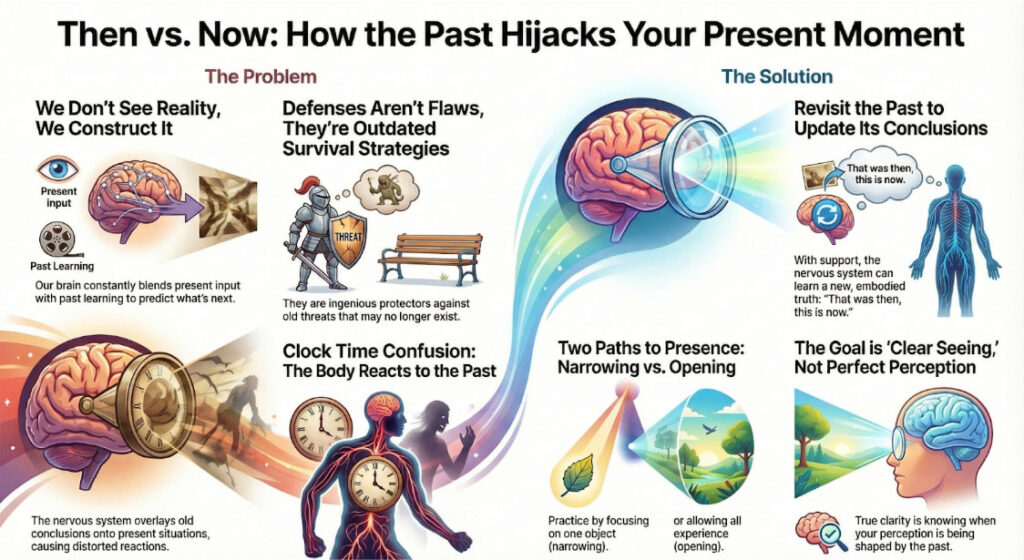
Neuroscience has given us many increasingly sophisticated ways to describe this—bottom-up processing, top-down processing, predictive coding—but the takeaway that matters clinically is simple: perception is not passive. We are not receiving reality as it is. We are constructing it, constantly, based on a blend of present input and past learning.

Which means we cannot work only with what’s happening “out there.” And we cannot work only with what’s happening “in here.” We have to work with both.

Why Defenses Matter

At this point, it’s tempting to wave our hands and say, yes, yes, perception is complex, and move on. But if we stop there, we miss the most important part: why the system distorts in the first place.
This is where defenses come in.

Defenses are not flaws. They are not moral failures or signs of immaturity. They are strategies—ingenious, often lifesaving strategies—that formed because something once felt threatening enough to require protection.

Psychology has spent over a century cataloguing what we don’t want: rigidity, fragility, masking, disconnection. What’s been less emphasized is what those unwanted states are trying to accomplish.

Judith Blackstone names the destination clearly: radical openness to experience—a maturity in which psychological and spiritual development converge. Not numbness. Not transcendence. Openness.

But you don’t get to openness by ripping away defenses. You get there by understanding what they’re protecting against.

Anyone who has tried to argue themselves out of a defense knows this doesn’t work. Defenses operate much more like a mother bear standing between her cubs and a perceived threat. Reasoning won’t disarm her. Proving safety might.

And one of the most stubborn traps we fall into is developing defenses about having defenses—a recursive loop that tightens rather than frees.

Time Distortion: When “Then” Masquerades as “Now”

Many of our most confusing defensive reactions are not actually about the present moment at all. They are about time.
More precisely, they are about clock time confusion—the system responding as if something from the past is happening now.
Psychodynamic theory gives us language for this: projection, projective identification, enactment, transference. But stripped of jargon, the process looks like this:
The body reacts.
The mind explains.
And the explanation feels like truth.
A tight chest becomes I’m being attacked.
A collapse becomes I’m alone.
Mobilization becomes I need to win.
From the inside, this does not feel like distortion. It feels like accurate perception.
What’s actually happening is that internal representations—conclusions learned earlier in life—are being carried forward and overlaid onto the present. The system is not asking, What’s happening now? It’s asking, What does this remind me of?
And because the brain is wired to prefer the familiar—even when the familiar is painful—it often recreates patterns that once made sense.
This is why we can be in an adult body, in a current relationship, with real options available—and still feel trapped, powerless, or fundamentally at fault.

Conscious Time Travel

Here’s the paradox: the same slipperiness of time that gets us into trouble can also be used to get us out. Trauma therapies like EMDR revealed something that talk therapy alone often could not: the nervous system can revisit the past from the present and finally complete experiences that were never finished.
When a system re-encounters an old memory with enough support, regulation, and adult perspective, it can learn something new—not conceptually, but bodily: That was then. This is now.
Often, what changes isn’t the memory itself, but the conclusions that were drawn from it. A child’s brain might decide:
Those conclusions may have made sense at the time. But they are not universal truths. They are context-bound predictions that outlived their usefulness.
When the nervous system updates those predictions, present-moment perception becomes clearer—not because the past is erased, but because it’s no longer driving the car.

Two ways of arriving in the present

Given how much information is coming at us, there are two reliable ways to practice arriving in the present moment.
The first is narrowing. Concentration practices intentionally focus attention on a single object—breath, sensation, movement. Instead of trying to track everything, we filter. Paradoxically, because the whole is present in every part, attending fully to one thing brings us into contact with everything.
The second is opening. Open awareness allows experience to arise without selecting an object at all. This can feel harder—especially if approached with an agenda—but when the nervous system is settled, it allows perception to widen naturally.
What matters most isn’t the technique. It’s the state of the system.
Practices that cultivate compassion, warmth, and connection often bring the nervous system into a ventral state where nothing needs to be different. When that happens, effort drops. Control drops. The system rests.
And presence arrives without force.

Clear seeing

Clock time distortion isn’t a personal failure. It’s what happens when protection outruns perception.
When we learn to recognize when the past is masquerading as the present—when we can say, this reaction belongs to then, not now—something loosens.
Defenses soften.
Stories lose their grip.
Choice reappears.
Clear seeing isn’t about perfect perception. It’s about knowing when perception is being shaped by something other than the present moment.
And that, ultimately, is what allows openness to replace defense—not through force, but through understanding.
Scroll to Top