

Neuroception How We Process Information
Our systems take in an unbelievable amount of stimuli all the time, the majority of which we aren’t able to consciously catch or process. Instead of garden hoses that look like snakes, and quickly apprehending the disconfirming truth–‘nope, just a hose! All is well!’–many of us seem stuck in distortion loops. Within these loops, we (mis)perceive based on our conditioning, and then expend energy– either (best case scenario within this paradigm) disentangling ourselves from our misperceptions, or, more problematically, living out–enacting– our misperceptions. We’ve got a lot of shit going on, coming in, rising to conscious awareness, being processed, all the time.
If we want to start to try to conceptualize what type of ‘stuff’ this is, we could borrow from the work of Daniel Siegel, who shows us four quadrants of experiential focus (to me this is much more helpful for clients than getting into the weeds of bottom up or top down processing, ‘sensing’ or ‘thinking’, as it gives us more of a holistic feel for how any of these arisings could in any moment become predominant as objects of awareness.)
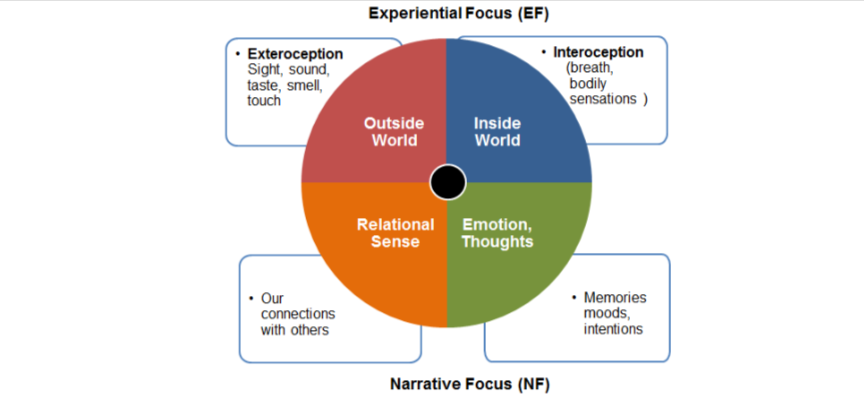
Instead of going through, quadrant by quadrant, the way I will try to demonstrate the complexity of Siegel’s diagram, where any single object might represent a flurry of simultaneous stimuli, is through show and tell. Let’s look at a couple of pictures:

These three pictures are single objects , each with a single animate focus, which we could think of either as 3 separate objects, or one photo collage. Yet when we really dig into what our brains do with these images, we start to see just how overwhelming and complex we are as humans, partially because of the phenomenon of association. One helpful way to track what our mind associates to is to slow down and see what might underlie what feels like an ‘instant’ emotional response. By using the phrase ‘what our mind associates to’ I’m bringing in the behavioral term that traces back to Pavlov and his dogs. Pavlov was the researcher now credited with naming the phenomenon of operant conditioning, based on his famous dogs, who associated the sound of a bell ringing with dinner. So without even having to see or smell dinner, the dogs just heard the sound of the bell, and started to drool. For the dogs, the bell was so tightly associated with, or paired with, dinner, that the bell itself led to the dogs drooling.
Much of the time, we barely notice that our minds have created associations. But when we slow down and inquire into what can feel like an ‘instantaneous’ response, often we’re able to piece together how our minds arrived at the reaction, which is usually based on a network of associations. For instance (especially as a therapist who’s worked with many people for many years), I could imagine that someone looking at the sunflower pic, living somewhere like Juneau, where I live, and where it rains or snows what feels like 350 days a year, might experience irritation or frustration arise, and the thought “It’s never sunny here—why do I live in such a rainy, dark place where flowers don’t grow?”.
Likewise, someone struggling with body image issues might think that the woman featured in the sunflower picture looks more attractive than they feel. Someone without too many resources might lament not being able to travel to places with fields of sunflowers. Someone with allergies might look at the sunflowers and see pollen, concluding: ‘that would be the last place I’d want to go!’. Someone single might wish they had a partner to travel with. Someone with a partner who feared flying, resulting in a dislike of travel, might start fantasizing about having a different partner. The picture of the puppy sleeping, cozy in a blanket, might help one person soften and relax. For another person, who maybe doesn’t like dogs, this picture could have the opposite effect. For me, who recently lost my beloved elderly dog, it makes perfect sense that BOTH affection and sadness arise.
Looking at the picture of the little girl with paint all over her might be “a glimmer” for one viewer, while another (who was perhaps struggling with fertility issues) might experience grief arising. Another person might fret over whether the paint touching the child’s skin is non-toxic. Another might go into sadness thinking about their own childhood experiences, which perhaps felt different than the one suggested by this image. A person in a couple in the phase of family life where young adult children just moved out of the house might wonder, ‘what holds us together now that the kids are grown up?”
In addition to all of the above associations or thoughts, which we could think of as being based on particular responses to the CONTENT contained in the pictures, someone else might feel like they’re not that big of a fan of the color yellow, and dislike the palette (a general, perhaps sensory aversion). Another person (maybe someone who appreciates the humor of https://stuffwhitepeoplelike.com/ or Portlandia) might feel like this collection of pictures seems to have been filtered through a very caucasian, privileged viewfinder. The point, which hopefully comes across quite glaringly, even while reading some of the options I offered, which may or may not have resonated as you looked at the pictures, is twofold.
Anekantavada: The Intersubjective Space
First, walking through an exercise like the one we just did hopefully demonstrates to us that we’re fast associators. We can end up down a rabbit hole of associations in a heartbeat, which ties back to our ‘clock time’ blindfold. Second, we really have no idea how, or what, another person’s nervous system perceives. Bringing in the sanskrit concept of ‘anekantavada’ potentially helps us grasp just how ungraspable we are to one another. While the literal translation would be something like, “no-one-perspective-ism”, the concept of anekantavada has come to signify “the multiplicity of viewpoints where truth and reality are perceived differently from diverse points of view, and no single point of view is the complete truth” (Salinas, Mirror Touch, p. 286). Formulating a one-size-fits all trigger model would be impossible, as no two people have the same exact way of perceiving, or relating to, what’s happened, even if we took two people who had the same experiences (and, let’s be honest, how rare is it to find people who have had the exact same experiences?). Recognizing that we’re all different, and we become differently regulated and dysregulated, gives us insight into how tricky it can feel to share a planet with roughly 8 billion people, with whom we might share nothing else.
So from a nervous system perspective, we ‘believe’ what feels ‘true’ to us, BUT what remains incredibly challenging to hold is that what feels true to us might not feel true to someone else. What triggers us or delights us, what nourishes us or stifles us, feels obvious to us, and thus we get tricked into thinking it should be not only obvious to everyone else (maybe especially to our loved ones)–but also that they should, or would, be triggered or delighted by the same things we are.
I would argue that this gets even more confusing because of how what I wrote above feels like it’s true some of the time, but not all of the time. If you remember back to my ‘hot stove’ learning/prediction example, we do well when we learn something that stays 100% predictable and consistent, every single time. Every single time I touch the hot stove, I get burned. It doesn’t matter the mood of the stove on a given day, it doesn’t matter if it’s raining or sunny out, (or whether there’s been a drought or forest fires precipitating the current rain or sun), it doesn’t matter if I’ve gotten a manicure recently. The hot stove burns my skin. If, every time we had an assumption around what might trigger (or glimmer 🙂) someone, we were wrong 100% of the time, we’d probably just ‘get it’ that we should stop assuming. But, instead of holding ‘the truth’ that we’re all entirely unique, we often assume that other people’s nervous systems operate exactly the same as our own (we can understand this as a blend of projection, transference, and schema theory, where we think we’ve learned something and then try to apply that learning unilaterally) partially because some–maybe even a lot–of the time, we’re not wrong in our assumptions or imaginings.
Perhaps because some things seem to hold universal appeal, or perhaps because we as human creatures share sensory proclivities, we assume that there are things ‘everybody’ likes, and things everybody dislikes, and if we could have more of the stuff that everybody likes, and less of the stuff that everybody dislikes, we could find and keep regulation (if we were using scientific language, ‘peace’ if we were using spiritual language). For example, where I live notwithstanding, people seem to prefer temperate, mild, sunny climates–more people seem to vacation in places like Hawaii than they do in the Arctic Circle. More people seem to like simple wholesome meals made of fresh ingredients than seem to enjoy tucking into a plate of pickled pig’s feet. More people seem to prefer a blend of work and relaxation to constant pressure and no breaks. More people seem to like soft, warm lamp light, as opposed to overhead fluorescent light. More people seem to like being around live plants than being in a concrete cell. If you gave people the option of having a beachfront porch where they could sit in a rocking chair and watch the ocean vs. a smelly, industrial paper factory, we can imagine most people would pick the porch. I feel like this ability to generalize actually gets us into a lot of trouble, because it means that we’re more likely to go into suffering if what we think is supposed to make us happy or satisfy us doesn’t, and because we feel shocked and bewildered when other people surprise us by having entirely different reactions and associations than we would expect based on our own systems and preferences.
The Content of Our Experience: Order of Operations Only Exists on the X-Axis
Taking a break for a moment from the Western scientific understanding of stimuli and brain processing, we can come over to thousands of years of Eastern nondual traditions, who simply conceptualize anything that arises as “the content of our experience”. To boil down an extremely complex conceptualization of liberation from a nondual perspective to one single phrase, we could say: peace and happiness come from recognizing that peace and happiness aren’t dependent on the content of our experience. But what I would argue, having gotten so intimately familiar with suffering, with myself and with clients, is that we so frequently ‘lose’ sight of this truth partially because our brains love to conceptualize problems, and imagine solutions to the problems, requiring an ‘order of operations.’ What gets tempting, such that many folks stay in this phase for long stretches of clock time, is to try to control or manage all of life’s triggers, and increase the glimmers. A saying I stumbled on recently encapsulates the wrong-mindedness of trying to focus externally: “Happy people build their inner world. Unhappy people blame their outer world.” Read the article titled: “Order-of-Operations Delusions: ‘If/Then’ Suffering” to see how we go into suffering by blaming our outer worlds, and then the one entitled “Pathwork & Daily Review Practice” for one antidote to this style of suffering.