

Utilizing a Chain Analysis
By the time I came to Polyvagal theory, 10 + years into practicing, it made perfect sense to me, and fit like a very welcome puzzle piece into existing ways of conceptualizing. My therapeutic training had instilled a healthy respect for, and awareness of, my mind’s unreliable thoughts, and the bits of neuroscience and evolutionary biology I’d learned over the years made me know that transient emotions could, and often successfully did, hijack my nervous system. I noticed that the way I held ideas about perceptual distortions– which I’d learned mostly from DBT and CBT–felt very similar to how I related to highschool biology class. For me, when I took biology, learning about cell growth, mitosis, the endoplasmic reticulum, it was as if one part of me accepted this incoming information as truth happening at the molecular level, a level that had very little to do with the felt sense in my body and in my daily life.
A chain analysis from DBT involves going backwards from an outcome to uncover what the ‘prompting event’ was. Echoing the diagrams from biology class, a chain analysis signals a scientific sensibility, similar to biological models. Even though my everyday experience of moods and behaviors felt wildly different than when everything got slowed down to this ‘nervous system molecular level’, in a way my brain started to think about emotional and psychological processes accordingly. Below is the diagram that outlines a particular chain analysis, Linehan’s ‘model for emotions’:
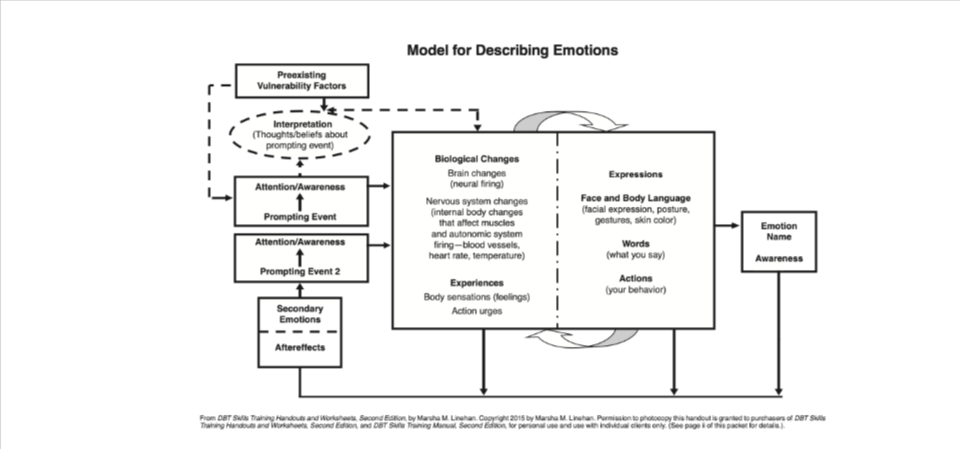
Learning this model back in 2011 set the stage for how I understood the influence stimuli have on our systems. I also remember fascination over a big debate my supervisor (who was also my DBT trainer) gestured to. She said that the dashed line (between the first prompting event, and the interpretation of the prompting event) was a concession to fancy researchers remaining in debate over, and in heated pursuit of, definitive answers around whether certain stimuli skipped over our cognitive processing and led to internal biological changes. Other folks seemed to think some cognitive awareness always happened, it just happened so fast, or in a different part of the brain than the language/meaning making/thought formation places, that we might not perceive conscious interpretation(s) of the stimuli.
In a nutshell, the model for describing emotions says that the function of emotions is to communicate. Emotions communicate in (by causing all kinds of biological changes, which we may or may not consciously notice, but we could see and measure if we had a person hooked up to machines like a blood pressure monitor, or an fMRI). Emotions also communicate out (through our non-verbals, what we say and what we do). So, walking through the model:
1) something happens (what we’re arbitrarily calling prompting event 1, though of course it’s not the first prompting event in our lives).
2) The mind may or may not come up with a conscious interpretation of what happened.
1)(also known as prompting events, triggers, arisings)
3 or 4) we have internal physiological responses, and outward communication(s).
4.5) generally at this point we might ‘know’ what we’re feeling
5) Then we ‘dump’ out into the aftereffects of prompting event 1, which generally segues directly into prompting event two.
To simplify and apply the model, let’s take an easy example: me walking outside (not in Alaska or Hawaii, where there are no snakes!) and seeing what appears to be a snake. My eyes, through something we now call exteroception, perceive a shape in the grass. Then we arrive at the step in the sequence which in 2011 was still pretty fuzzy: perhaps our cognitive mind CONSCIOUSLY thinks a thought “Oh my, that’s a snake!”. Or, perhaps we skip the conscious cognitive interpretive process, and instead jump into the physiological processes (that represent sympathetic mobilization). The heart starts to pound, blood pressure changes, thoughts might disappear or race, cortisol and adrenaline get released (to give us energy to flee or fight). Next, (let’s say we were outside with someone else), we yelp, or gasp aloud. Our gasp would alert the other person to danger. Now both of our systems would be mobilized, primed to survive what we perceive as danger. At this point of the process, we might imagine that if a friendly researcher popped in and asked us what we were feeling, we would respond: “FEAR!”. Alas, if we didn’t freak out, jump back, catch our foot in a ditch and twist an ankle, and instead kept ourselves calm(ish) long enough to see “oh, I thought that was a snake, but really I see now it’s just a garden hose”, both of us would be able to get ‘back to baseline’, no worse for wear.
This example fleshes out how first we have to be sure we’ve de-identified from distortions, before we ‘sit with’ the emotions, or pain. This misperceiving-the-garden-hose-as-snake example uncovers how it would be a complete waste of time to ‘sit with’ our fear, when the fear is based entirely on a misperception. In our current climate, which potentially has just swung (or started swinging) from a ‘it’s better not to have any feelings at all’ place, I think we’ve gotten a bit cloudy about when we’re supposed to ‘feel our feelings’ vs. when we’re supposed to challenge them. With clients, I often say: we want to make sure we’re not believing [what an ego part] thinks is happening hook line and sinker, but we also (equally!) don’t want to repress, ignore, avoid or shut down what we’re feeling. This is yet another way of working with Nisargadatta’s teaching: flowing between the wisdom (that teaches us everywhere we may’ve gotten tricked) and love
It’s arbitrary whether we go to the internal physiological box after the prompting event, or the external box.