

Neither Journey Nor Destination
“Actually, all paths lead away from the truth…How’s that? All paths. There’s no such thing as a path to the truth. The truth’s already here. Where are you going?” -Adyashanti
Regardless of what words people use, it seemed to me like the majority of sincere seekers seek the same thing.
Raymond Carver style, what we talk about when we talk about awakening involves:
- an understanding of fundamental truths about existence and consciousness
- the transcendence of illusion, seeing through the ego, and disentanglement with attachments, desires, and conditioned patterns of thinking
- nondual awareness, where the distinction between self and the external world dissolves, and we have access to the direct felt experience of the unity and interconnectedness of all
- inner peace, or a felt sense of contentment and joy not dependent on external circumstances
- an expansive sense of compassion, love, and empathy
- liberation from suffering and dissatisfaction accompanying an understanding of the impermanent and illusory nature of life
All of which sounds pretty great. And yet–residing in any of these feels as hard to come by as the philosopher’s stone. And in fact, I would posit that for many contemporary Westerners, the concept of enlightenment, particularly of ‘achieving’ or ‘realizing’ enlightenment–feels as fictional as Indiana Jones’ quest for the holy grail. A colleague with over 15 years of psychotherapeutic and spiritual practice under his belt, who’d engaged deeply with communities like Naropa in Colorado, said, when I told him I was writing a book about how we get enlightenment wrong: “I thought enlightenment wasn’t possible?”.
Adyashanti, a nondual teacher says “Enlightenment is, in the end, nothing more than the natural state of being.” And Rupert Spira, embodying a different (perhaps mindier) flavor of awakeness than Adya, says “When, through understanding, we realize that what we aim for can never be found in an object, substance, activity, relationship or state, our longing loses its direction, flows back to its source, and is revealed as the love it has been seeking.” A beautiful sentiment, yet for the person who feels like they’re still seeking, a person who doesn’t feel ‘realized’ like Spira, one remains flummoxed.
The longing itself seems to be what pushes us forward. Our yearning brings us back to the cushion, to our therapist’s couch, to the yoga mat. And yet, the longing itself, we’ve been told, is the very thing that keeps us locked in suffering, which is what we’re hoping enlightenment will help us transcend. I began to wonder: what if this brutal, exhausting loop-de-loop, where we catch glimpses of understanding, transcendence, nondual Awareness, inner peace, compassion and freedom from suffering–but then feel like we lose them– is just a misunderstanding? What if this confusion isn’t a necessary part of the process?
The Mapless Map: Confusion about Awakening
As a complex and multi-faceted phenomenon understood differently across various cultures, traditions, and teachings, enlightenment features a couple of fascinating paradoxes that emerge when you start to inquire deeply. For me, the first paradox has to do with the mind-breaking riddle both Adya and Rupert Spira gesture towards. When we ‘arrive’ at awakening, we find ourselves in the very place we started. Certain frameworks (like a nondual frame) tell us we’re already enlightened, that we don’t need to do any work or get attached to any practices, we don’t need to strive for enlightenment or awakening, because the Awareness itself is right there, perfect just as it is. “Our true nature”, as Almaas says, “…does not need work; it is primordially pure and complete.” While this is absolutely true, I would say, for the vast majority of us, especially those first beginning therapy, first engaging with teachers and practices in any lineage that cares about becoming who you truly are, things feel like a shitshow.
Most of us don’t seem to have access to this ‘primordially pure and complete true nature’ from the outset. As Brene Brown tells us, “We are the most in-debt, obese, addicted and medicated adult cohort in U.S. history.” And Brene cited this research before the pandemic, which I can’t imagine helped things. Richard Schwartz said, “Working with hundreds of clients for more than two decades, some of whom were severely abused and show severe symptoms, has convinced me that everyone has this healthy and healing Self
Almaas, A. H. The inner journey home: The soul’s realization of the unity of reality. Shambhala Publications, 2004.
“Self” within the IFS frame has the same meaning as Almaas’s “true nature’. I use the phrases “the awareness”, “awareness itself”, Core Self, and essence interchangeably throughout this piece
despite the fact that many people initially have very little access to it.” Almaas ends his bit about our true nature not needing work by conceding “we need to work on ourselves in order to become sufficiently open and clear to even glimpse this nature.” In other words: do healing work, so you can start to perceive your beingness, which has always been there (but which probably seemed invisible to you until you start working). And then, know yourself as BOTH (the messy and complex ever-changing human form, and the awareness itself, your beingness which doesn’t change).
In a chicken and egg way, I agree (personally + clinically) with Almaas and Schwartz. It seems to me like the starting place is working with ourselves–with healing. As we do this healing work (what many call ‘personal process work’), more and more access to the awareness itself opens up. If we wanted to speak in the somewhat obscure language of David Hawkins, or, perhaps even more fringe, Ramaji, we could say that our ‘level of consciousness’ rises. As the level of consciousness goes up, we have more access to the next bits that need to be processed, and so on in this same zigzagging fashion. According to a ‘Levels of Consciousness’ [LOC]schema (what my shamanic friend’s Helping Spirits incongruously but brilliantly likened to a ‘spiritual credit score’), you’re conveniently given a number.
The idea is that by the time you’ve reached LOC 1000, you realize the truth of your essential nature, which is that you are everything and nothing, both form and formless. With this understanding of the essential nature of the Self, separateness recedes. Proponents of this LOC conceptualization say that the majority of people alive today reside well below the 500s. Seekers live in the upper 500s. Yogis who have apprehended non-doership have crossed over into the 600s, with certain markers that let you know you’re cruising through the 700s, 800s and 900s until you (finally!) arrive at LOC 1000, at which point you’re told, paradoxically of course, perhaps with nondual nonhumor— ‘that was kind of like a carrot to keep you motivated, now the REAL work begins!’.
For me, I think about this as working within a paradox. We could process our faces off, but if we never shift our patterns, and just keep creating dramas and accruing traumas (which then embed in the body), we don’t seem to ‘get’ anywhere–we still don’t feel like we have access to the essence which doesn’t need any work. On the other hand, we can have peak experiences that awe and dazzle us, and maybe even give us a glimpse of transcendence. But when the experience fades, we feel back at square one, standing
But in all seriousness, I would say that my having been told I was LOC 1000, and still living in the world, still having life issues and career challenges and conflicts with partners and friends made me question if I was *really* at LOC 1000, if LOC 1000 was ‘real’ or not. If it was real, and I’d arrived, how come LOC 1000 felt totally different than my egoic mind thought it would?
amidst the rubble in the world of form, as if the glimpse of essence–the realm of being– was a mirage, that faded back to invisibility.
Hence, people who seem to be in therapy forever, or those who hopscotch from one self-actualization or spiritual community to the next. Though always ‘working on themselves’, or chasing peak experiences, it’s unclear whether the work serves anything (other than paying the bills of the therapists and teachers). And it’s unclear whether the peak experiences open into stabilized awakening. If, on the other hand, we don’t engage in healing (which for my purposes includes practices like shadow work, embodiment work, cognitive defusion and trauma processing), our level of consciousness doesn’t seem to shift at all. And mostly, people who aren’t –and haven’t–engaged in any healing process work seem to be having a pretty rough time in the realm of becoming.
There are those of us who get too focused on our pathology + wounds, everything we feel is broken or incomplete about ourselves, and those of us who fit the ‘spiritual bypasser’ stereotype, and get blissed out, in denial about the internal shadiness we have going on, which transpires nonetheless, below the level of conscious awareness. Beyond the pitfalls and cul-de-sacs we encounter along the way, I also fear that the diversity of paths, the complexity of the concepts, and the zillion things that arise in the realm of becoming functionally mean that people feel like they’re in the dark, or need someone else to give them a light, when really they just need a clearer sense of themselves as light.
All of which brings me to the second paradox on the path to enlightenment. If the path really can be understood as a path, it seems like it would be so nice to have a ‘map’ of the path. Yet, especially in our contemporary world, there are many paths, and many people who say that even the idea of a path is wrong-minded. Different people go at different paces. There’s fuzziness about the ‘end’ of the path (and debate about whether healing work ever ends, other than when we die). Various paths have different markers by which you might measure ‘where you are’. To articulate just a few historical, explicitly spiritual maps that correspond with particular lineages, we could gesture to things like “the Seven Valleys” of Sufism, Zen’s “Five Ranks of Tozan”, the Seven Stages of Advaita Vedanta, and the Theravadan Buddhist map of the elders, which outlines stages of insight. Some writers have pointed out that if we take maps like these in broad strokes, they outline five stages: a pre-enlightenment stage, an enlightenment stage, and then
A term that became popular in the 1980’s, coined by the late John Welwood, a Buddhist teacher and psychotherapist who observed the phenomenon in his own spiritual community.
Ramaji, 1000: The Levels of Consciousness and a Map of the Stages of Awakening for Spiritual Seekers and Teachers. 2019.
subsequent stages that involve deepening into enlightenment. Even this clarification, that enlightenment is something it’s possible to ‘deepen into’, offers a shift from a framework or concept of enlightenment that a typical lay person or beginning meditator might hold. But certainly we all know people who have undertaken training, been in treatment, or engaged in practices for years–maybe even ‘graduating’ from programs, and becoming teachers or masters themselves– who do not seem to embody whatever they supposedly learned or practiced. And most paths, especially ones associated with secular mindfulness, don’t even fit neatly into a ‘path’ form.
While listening to a podcast (which I’d been drawn to because of its name, “After Awakening”), I became laser-focused on one part of the discussion by the podcast host, Ryan Burton, and his guest, Tim Hwang. Both identified as long-time meditators who’d found “Pragmatic dharma” communities as they’d deepened into their practices. Pragmatic Dharma communities appear to focus on applying practical approaches to meditation, mindfulness, and Buddhist teachings by exploring and applying direct experiences of meditation and insight to daily life. Within these communities, where the relevant players are people like Tina Rasmussen, Daniel Ingram and Kenneth Folk, there’s an emphasis on direct experience over traditional dogma or beliefs, an integration of contemporary psychology and science with older contemplative practices, and a desire to bridge the gap between ancient wisdom and contemporary understanding.
Hwang talked about how he’d felt a need to “dig deeper” after being introduced to secular mindfulness, which, while accessible, felt like it“ leaves behind a whole rich tradition and orientation to practice”. Hwang expressed that he wanted to “master meditation”, and thus began working with nondual teacher Kenneth Folk. Talking about how it was helpful both to “get pointers” but also to “contextualize what you’re going through”, Hwang says that for him, having a teacher meant that it felt like it [understanding] “permeates through you –you absorb it through them” [the teacher].
Burton then asks Hwang, “And in your experience in [secular mindfulness communities], are fruition or cessation experiences a part of their map? Or do they not go that far?”. Hwang replies with a no, saying that “in secular mindfulness there’s no talk about attainments at all… they speak about enlightenment, but they don’t really talk about how to get there.” Hwang juxtaposes the pragmatic dharma community with the secular mindfulness community, saying that “they’re all about mastery and techniques,
Burton, Ryan J., narrator. “Pragmatic Dharma and Insight Circles” After Awakening, episode 10, 5/4/2022, https://www.afterawakening.com/afterawakening/episode/2023fe2c/tim-hwang-pragmatic-dharma-and-insight-cycles.
and also experimenting, Using yourself to experiment.” He says, “I found that really inspiring-this idea of ‘leveling up’. There’s maps and there’s progressions. It’s like, I can actually see where this is going.”
Hwang’s articulation of shifting from ‘hanging out’ in a secular mindfulness realm, to engaging with pragmatic dharma communities, and first encountering the ‘maps’ that allowed him to start to see where the practices ‘went’, seems to me to be a very helpful glimpse into the first few conceptual prisons people can get stuck.
Behind prison door number one, we have the possibly endless limbo of secular mindfulness, where we practice indefinitely, finding perhaps some immediate benefits (like increased concentration or relaxation), but often end up metaphorically treading water, feeling like we’re expending a lot of energy on practice, while perpetually sitting with the niggling feeling that we’re missing something. Behind prison door number two, with an apprehension of various ‘stages of insight’, or ‘maps’, we can get fixated on the map itself, and wrong-mindedly start to relate to the map as if the map is the point, or that we’re locked into a particular stage or place on the map. Shinzen Young, in The Science of Enlightenment, writes brilliantly about this conundrum, hilariously noting:
Spiritual practice is often described as a kind of path with recognizable stages. But such a practice-as-path paradigm can involve some pitfalls. In colloquial usage, the word “path” implies a starting point, a destination, and a distance separating the two. But if enlightenment means realizing where you’ve always been, then the distance between the starting point and the destination must be zero, contradicting the very concept of a path. Moreover, when we describe spirituality as a path, it immediately sets up all kinds of craving, aversion, confusion, and unhelpful comparisons. People wish they were at some other place on the path, and they struggle to get there. When we think about spirituality as a path, we create the idea of enlightenment as an object out there in the future, separate from ourselves. As teachers, we’re damned if we do and damned if we don’t. If we describe a path to enlightenment, it leads to the aforementioned problems. If we fail to describe a path, people won’t have motivation or direction, and they won’t be sensitive to the benchmarks…Thus to teach about enlightenment is to mislead people. On the other hand, to fail to teach about enlightenment is also to mislead people.
I love Young’s articulation of how we’re ‘damned if we do, and damned if we don’t’. Moved by his candor, I want to join him in explicitly stating which side of damnation I choose. I’ll spell it out: I choose both. I choose flowing.
Young, Shinzen. The science of enlightenment: how meditation works. Louisville, CO: Sounds True, 2016. (p.4-5)
Perhaps, trickster-style, the aim of my larger body of work comes out of my optimistic thought that I can outline a way of utilizing the understanding that there is no separate ‘object’ of enlightenment to undertake the work that comes up for you on your path towards enlightenment. Or, in simpler terms: what I put forth in this text is a vision of how to hold the paradoxical stance that you’re already enlightened, while also (lovingly!) recognizing every aspect that initially feels unenlightened. According to this conceptualization, we always, and already, have 24/7, on-demand access to the Beingness dimension of ourSelves. AND, in the realm of Becoming, embedded trauma, unprocessed material from childhood, every false belief and wounded part appear to arise, kicking and screaming, making it seem like all of our unenlightened bits are sitting on top of (perhaps completely obscuring) our enlightened Beingness.
What I’ve come to suspect recently is that our multifaceted confusion about what Maslow lays out in his definition of self-actualization, the extremely complex paradox of “becoming what we already are”, “becoming more and more what one is”, keeps many sincere seekers and therapy-goers locked in a misunderstanding. Further, a part of me frets that we as therapists and spiritual teachers engage in ways of talking and explaining that actually contribute to staying stuck. The hazardous idea, or assumption, of “progression” along a “personal process path” increases the likelihood of stagnation in conceptual prisons. And as we ourselves build these prisons, enclosing ourselves as spiritual teachers and therapists in them, we unconsciously collude with reinforcing the prison cell walls for our clients and students. We could think of this misunderstanding as difficulty grasping the truth of our nondual nature, which is both simultaneously (and neither solely) a state of being AND of becoming.
At the risk of making things sound even more complicated, I’ll bring in John Prendergast’s conceptualization of psychotherapy (“and all of life for that matter”), to help us understand how we might be missing the boat of becoming AND being. Prendergast writes:
It may be helpful to think of psychotherapy, and all of life for that matter, as having a horizontal and vertical dimension. The horizontal refers to the realm of form–the evolution of phenomenal life in time and space. The vertical refers to that which is formless and exists outside of time and space. Psychology, like all disciplines, evolves on the horizontal plane as new information about the
You know how sometimes you’ll have a book on your shelf for years, and never even crack it open, and then one day, for no particular reason, you pick it up and start reading and it feels like it speaks exactly to the questions most alive for you at that moment? And it blows the roof of your head off? That was precisely the experience I had with the book The Sacred Mirror, Nondual Wisdom & Psychotherapy Volume 1. The collection brought together the most respected Western nondual teachers + practicing psychotherapists at the time it was published, in 2003, to think through, write about, and puzzle over how nonduality and psychotherapy go together. This excerpt is from Prendergast’s introduction to the volume.
development and functioning of the human body/mind is discovered and synthesized, leading to new schools of thought. While the concept of nondual awareness has already been incorporated horizontally into Transpersonal Integral frameworks, its main effect occurs vertically as practitioners deepen into their own true nature.
Because I (almost immediately) start to feel like my eyes cross and my brains short-circuits when I read writers like Prendergast undertake the impossible task of trying to put non-verbal wisdom into language, I am taking the liberty of simplifying these concepts down to (what for me) feels more manageable. First, here is an image:
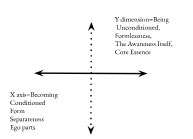
What Prendergast is calling the horizontal plane, the “realm of form”, we could think of as the realm of becoming. Here, since everything is in flux, there’s always more to work with, more to become. In the vertical dimension, “that which is formless and exists outside of time and space”, there’s no work to do, nothing to become. There is simply Being. The awareness itself remains unchanged, never gets broken,
Sacred Mirror, p. 5
No disrespect intended. I see Prendergast, and actually all the folks who contributed to that collection, as brilliant forerunners of Western writing about nonduality! Alas, my eyes still cross.
Misconceptions
From the perspective of time-distorted misunderstandings, we see two major and equally problematic (though understandable) common sticking points that keep the ‘therapy lifers’, or the 25 year Vipassana practitioners, feeling like they’re in the dark, still wrestling with the same issues. And then a slightly different (non-time oriented misunderstanding) which seems more often to befall those seeking enlightenment.
The Eternally Present Past
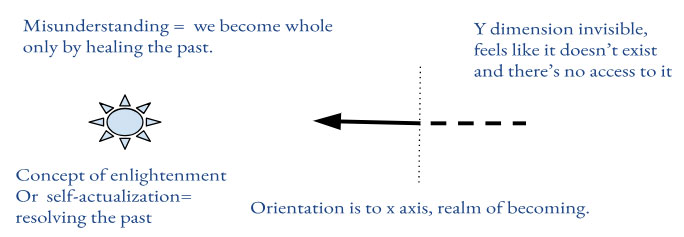
The first misunderstanding involves an individual getting so identified with the wounds from the past, the dynamics from family of origin, the traumatic things that have accrued in the nervous system over time, that they essentially believe they are their wounds. People who lean this way seem to feel like they are who they were, they are what happened to them. I adore the psychotherapist and author Bonnie Badenoch, and love the way she quotes neuroscientist Dan Siegel in her excellent book, The Heart of Trauma: Healing the Embodied Brain in the Context of Relationships. She writes “When implicit memory associated with embedded trauma is touched and awakened in our bodies and our perceptions, it is experienced as happening in the present moment, often without our being aware that it has its origins in the past. (Seigel, 2015b). In this way, we might call implicit memory “the eternally present past”. The felt experience of the present moment is of being triggered and activated–hanging out in a state of sympathetic mobilization–such that it feels like we are actually back in what happened in the past, continuously re-experiencing it. The deficiency story is about not having resolved the past. Not being able to get over, or
academia is that the mind, on its own, is probably never going to get you out of the Truman-show dome-style-illusion that the conceptual realm is the totality of reality.
I almost hesitate to write this sentence, because, duh–of course it does, it’s a concept. All concepts live in the realm of becoming. But I do write it because I think not seeing that obvious point contributes to our misunderstandings.
(Badenoch, 2011. p. 8)
let go of, what has happened. The last line of F. Scott Fitzgerald’s The Great Gatsby “So we beat on, boats against the current, borne back ceaselessly into the past” evocatively summarizes the paradoxical nature of the wrong-minded effort we expend as we perceive ourselves to be caught in this difficult loop.
Visually, we could represent this misunderstanding with our Prendergastian x-y metaphor as:
Striving for X-Axis Perfection: Are We There Yet?
The second time-related stuck place on the X-axis, perhaps an equal-but-opposite stuck place to the living- in-the-past stuck place, houses those who find themselves striving for an imagined future enlightenment, or cure. The strivers keep sitting, keep practicing, keep processing, but go nowhere, holding out for a finish line that keeps receding. People who lean this way seem preoccupied by an imagined future, lost in a permanent state of becoming (ironically doing so even as they pine and burn for ‘being’). Rupert Spira sweetly compares this to walking around the house looking for the glasses you think you’ve misplaced, when really they are perched on the top of your head. The deficiency story is a tale of not quite being there yet, chasing peace and well-being, thinking that there’s still something missing, that there’s something outside of yourself you don’t have that you need.
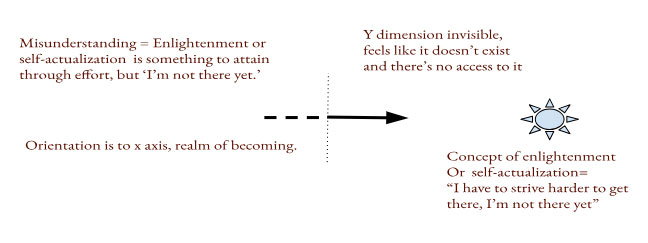
It’s intriguing to me to think about how our perceptions of our own human limitations and our sense of our teachers and therapists play into this misunderstanding. As I gestured to in the section on my experiences with Spirit Rock teachers, therapists and analysts of my own, and later in life, shamanic practitioners, energy
workers, and other alternative practitioners I’ve worked with, it feels like an ego part catches hold of the idea that wherever anyone displays human “x-axis” stuff, this ego part starts to tear the person down from the pedestal that a different ego part put them on in the first place.
And, perhaps for a perfectionistic ego part, the tendency is to wield any x-axis stuff we ourselves have going on as more ‘evidence’ that we’re not there yet. If we find ourselves feeling like we’re stuck in this endless striving camp, it might be helpful to remind ourselves that there is (literally) no perfection possible in the realm of becoming. By definition, we would never be able to say that we had a ‘perfect’ idea (because we’d always be measuring that idea against any previous idea, and unable to fathom any imagined future idea that might be better). We would never be able to say we are ‘perfectly’ beautiful, or ‘perfectly’ smart, or ‘perfectly’ relaxed, or ‘perfectly’ salaried (and on and on–just plug in any word after the word perfectly and we start to see it’s not possible in the relative, comparative, subjective, conditioned realm). In this way, we can see that this misunderstanding involves a wrong-minded sense of what’s possible on the x-axis. We cannot ‘achieve’ perfection in the realm of becoming, in the same way that we couldn’t achieve a state of perfect dryness while swimming in the ocean: we haven’t ‘failed’ at achieving dryness, we’ve misunderstood the ocean.
Striving for ‘More’ Awareness: Fake Climbing Up an Ill-conceived Y
What I would call a third common misunderstanding has more to do with the y-dimension, and thus doesn’t get into time (because there is no time in the realm of timelessness). This misunderstanding seems to come from models that suggest we start out with a small amount of awareness, which then increases with practice, grace, or being around someone else (a guru) who has this ‘greater’ awareness. Visually, it might look like this:
Maybe it’s a different part, or maybe it’s the flip side of the coin of the same ego part
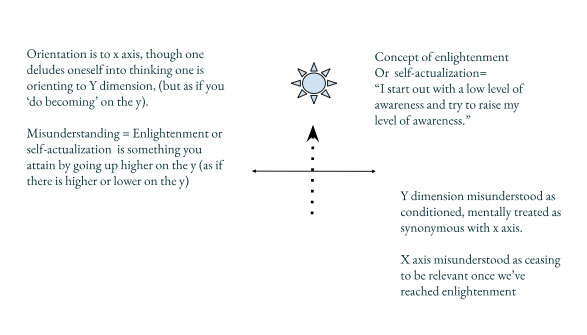
In some ways I suspect part of what makes people have such an aversive reaction to the Level of Consciousness conceptualization has to do with this misunderstanding. Peter Fenner, in his book Radiant Mind, goes into very helpful detail about phases of growth. He says we begin with disconnection, marked by fear. Then we move into conflict. From conflict into codependence, from codependence to coexistence, and then to paradox. We move from paradox to our final state of “radiant mind”, which is the only state “unconditioned” by moods or emotions.
While I find Fenner’s conceptualization of these phases of growth extremely clarifying and useful, (and even though he puts in the caveat that “there is no strict order to how we traverse these phases, though there is an overall sense of direction”) I also feel that these kinds of conceptualizations sometimes trick people into the illusion of the awareness existing along an axis, with greater awareness and lesser awareness as the points of reference. This illusion could leave people (especially those who aren’t already resting in nondual understanding of their essential nature) feeling (understandably!) stymied, like it’s impossible for them to ‘get’ to greater awareness within a y dimension that has no greater or lesser. Mistakenly treating the y dimension in this way means we’ve ‘lost the plot.’ I also suspect it leads to a parallel confusion to the misunderstanding of the future-oriented strivers, leaving people with the implicit assumption that by the
time we got to ‘the end’, to ‘radiant mind’, we’d be ‘done’. Perhaps in our fantasies we’d be having tea with the Dalai Lama, cackling to our pal Pema Chodron over an amusing anecdote, going on bike rides with Adyashanti and generally having no problems or issues whatsoever. And if we are (still) having problems, this wrong-minded, egoic- thinking-part tells us that the problems are ‘evidence’ we haven’t ‘gotten’ to the awareness (yet).
How I’ve come to understand this is that I’m 100% sure Fenner himself absolutely knows all this (and for the record, did articulate, in language, that these are phases of growth, and thus by definition could only be on Prendergast’s horizontal plane, as they aim to capture the process of becoming). But Fenner’s reader– who has yet to fully stabilize in radiant mind– presumes that this “growth” would be happening vertically, as if one starts out with a low level of awareness which then increases as you ‘ascend’ up a ladder of awareness. In the absence of clear seeing, Fenner’s reader’s ego part, who has mistakenly treated the vertical dimension as if it’s the horizontal axis, then imagines once we ‘get’ to enlightenment, we’d no longer have to deal with all the hullabaloo of becoming (the horizontal dimension). Or, as one friend said, “I think my ego thought [LOC 1000] would be the end of suffering AND pain.”
Because I’ve had this come up so frequently in spirited conversation with clients, I will perhaps belabor the point I’m trying to make using a sailing metaphor. We can imagine that sailing in a hurricane would likely be more challenging than sailing under clear skies, on calm seas. Ego parts (all too easily) get attached to the experience of sailing under clear skies, and begin to associate pleasure with pleasant weather. Once we begin to perceive the truth of our nondual nature, we think we ‘get’ that our peace and wellbeing aren’t contingent on clear skies. Sometimes, a funny ego part who wants to take this understanding and run with it, jumps all the way to a different misunderstanding, involving trying to dismiss the weather entirely. Yet, sailing in a real hurricane (not a mental hurricane of suffering) has implications. A more complete understanding would involve recognizing that while hurricanes exist, and influence us on the x, peace and wellbeing (which come from accessing the truth of our nondual nature) aren’t weather-dependent.
For a fascinating read that expresses an adjacent point to the simpler one I’m making here, I recommend Mark Manson’s The Rise and Fall of Ken Wilber
Beginning a Life Lived from True Nature
To unmask the ego, let’s explore how we might differentiate skillful action from this type of ‘awareness’ striving. To me, skillfulness involves compassionate participation in life, from what we might think of as our core Self (or, the awareness itself). When we brush our teeth (which most of us do, fairly effortlessly, twice daily), we don’t do so because we secretly believe that brushing our teeth will lead to enlightenment. We aren’t thinking we will become an entirely different person, or experience a different set of emotions, once we brush. We don’t mentally rehearse this kind of action. We brush out of habit, we brush because it’s not that difficult— nothing in particular stands in our way. And we brush because we perceive both the benefit of taking care of our teeth, and the consequences of not taking care of our teeth.
I choose the example of teeth-brushing with some trepidation, but intentionally. A friend recently referred to a piece of wisdom he heard from a nondual teacher. A student asked something like, “If I don’t have to do anything, then why do I keep having to do things?”. In this particular teaching, the teacher (who might’ve been Jean Klein, or Rupert Spira) said something like: “nonduality points us to the underlying truth of the awareness itself—but don’t look to nonduality to clean your teeth for you. Brush your teeth! Go to the dentist!” In other words, in the realm of becoming, we still have teeth. Being stabilized in the truth of our nondual nature doesn’t mean we won’t get cavities if we don’t brush our teeth. The horizontal dimension doesn’t disappear.
Because I recognize these kinds of minute arguments can seem ever more complex (and thus stop facilitating clear seeing, and instead give our greedy ego parts more of a mental bone to chew on), I’ll end with two quotations from awakened people to flesh out the subtleties discussed above. Rupert Spira illuminates the point about how neither the x nor the y changes or disappears (in the case of the x, because it’s constantly in flux; in the case of the y, because it’s never in flux), but that it’s the perspective that seems to influence our relationship to the x and y. Spira says, “There is no separate, inside self and no separate outside object, other or world. Rather, there is one seamless, intimate totality, always changing when viewed from the perspective of objects, never changing when viewed from the perspective of totality.” Adyashanti speaks to the paradox of our experience of awakening representing both an ending and a beginning, in his simple and straightforward way. He shares: “Awakening is the end of seeking, the end of the seeker, but it is the beginning of a life lived from your true nature.”
Exiles (Wounded parts) carry the emotions, memories, and sensations from past distressing experiences. Managers often want to keep these feelings out of conscious awareness and thus try to keep vulnerable, needy parts in exile through control and prevention strategies. Firefighters try to douse the intense emotions and unmet needs of the wounded parts by avoidance, distraction and numbing strategies.