
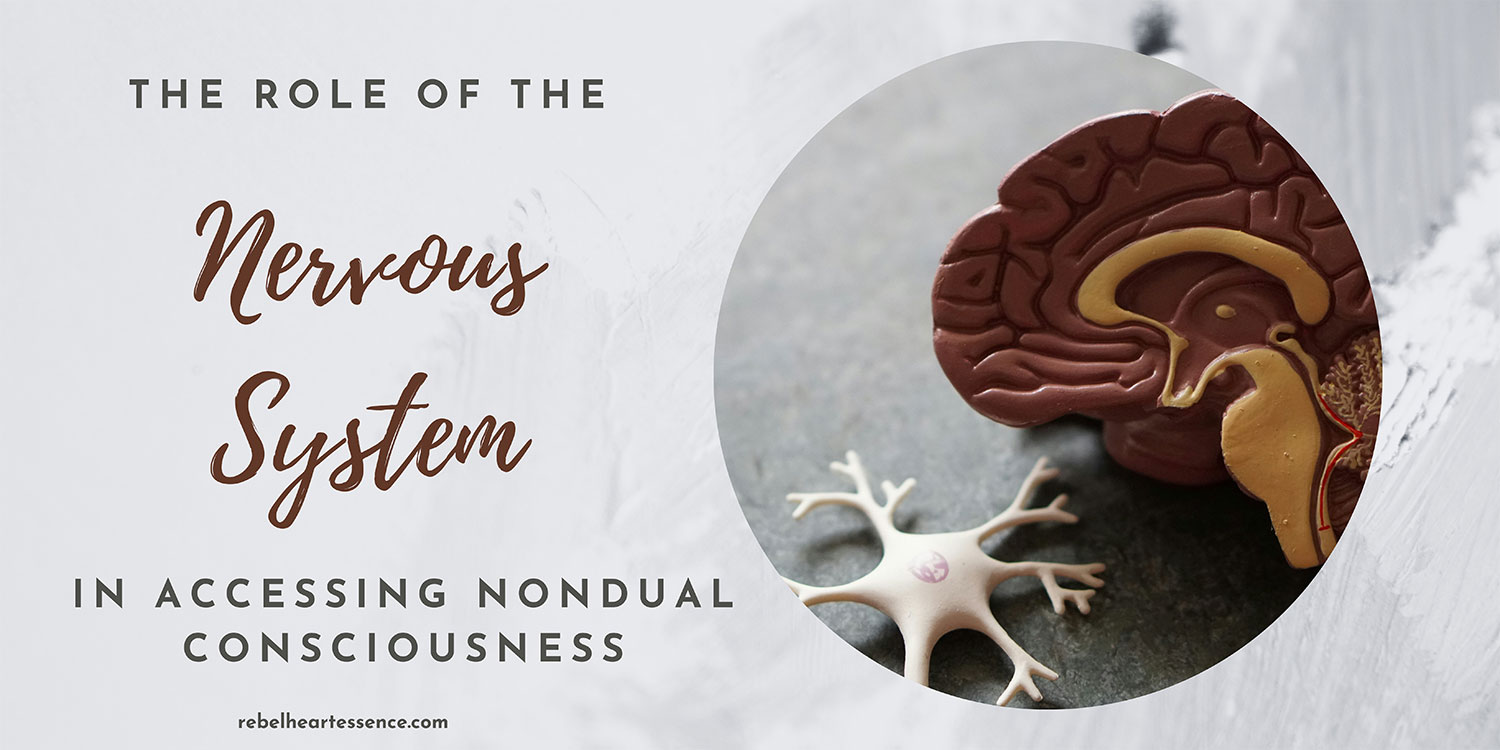
Role of Nervous System Regulation in Accessing Nondual Consciousness

The Body Was Never the Problem

For a long time, I carried a quiet spiritual assumption I barely knew I had: that awakening meant rising above what happens in the body.

This belief takes many forms. Sometimes it appears as an ideal of serenity so pristine that no contraction is allowed to enter the room. Sometimes it shows up philosophically, as devotion to teachings that emphasize disidentification from form. And sometimes it arrives clinically, disguised as competence—the idea that if we just regulate enough, process enough, resource enough, we’ll finally arrive at a stable baseline where we are no longer reactive, no longer hijacked, no longer pulled into duality.

Even within traditions I love, I began to notice how this assumption subtly distorts practice. Read with grounding, teachings about not being the body point toward something liberating: Awareness is not limited to sensation, personality, or physiology. Read without grounding, they can become a spiritual crowbar—used to pry ourselves away from embodiment, to treat somatic experience as a lesser reality, to interpret activation as evidence that we’re failing to awaken.

But the more I worked with people’s bodies—and the more I listened to my own—the less convincing transcendence-as-escape became.

Awareness excludes nothing. Which means it does not exclude the body.

Inclusion, Not Transcendence

The metaphor of the ocean in a drop matters here. A drop is not the whole ocean—and yet the ocean is fully present in the drop. Saltwater is saltwater.

In the same way, if sensation, emotion, fear, contraction, and ease all arise within Awareness, then awakening cannot be a project of getting rid of embodiment. It has to be an inclusion project: learning to be present with bodily experience without collapsing into identification with it.

This shift was not just philosophically relieving. It changed the way I understood healing.

Because once you take the body seriously, something becomes both obvious and startling: the body does not organize itself around enlightenment. It organizes itself around protection.

How the Body Creates “Other”

When the nervous system perceives threat, perception narrows. The world becomes a problem to solve. People become variables. Relationship becomes risk.

This is not a moral failure or a spiritual immaturity. It is survival physiology doing exactly what it evolved to do.

Clinically, we have many names for this—defense, projection, splitting. Spiritually, we talk about ego and separation. But underneath the language, the mechanism is simple: when the system senses danger, it runs an us-versus-them script.

This is why it’s so hard to stay open in conflict. Why a single text message can turn a grounded adult into a panicked child with a legal brief forming in their head. Why people feel bewildered by who they become when activated.

From the inside, this doesn’t feel like distortion. It feels like reality.

The body supplies sensation—tight throat, hot face, collapsing belly—and thought follows faithfully: Something is wrong. Someone is wrong. I am not safe. You are the problem.

This is the moment “other” is born.

Sometimes it’s loud: fight, flight, urgency, obsession, anger.

Sometimes it’s quiet: collapse, withdrawal, numbness, dissociation.

Different expressions. Same underlying logic.

Protection wins. Connection loses. Experience reorganizes itself around separation.

This is not a character flaw. It is a design feature.

And the more we understand this, the less we need to interpret activation as evidence that we’re broken—or spiritually behind.

The False Promise of Permanent Regulation

One of the most painful misunderstandings I see in both therapy culture and spiritual culture is the belief that the goal is a static end state.

In psychotherapy, it often appears as a treatment fantasy: Once I process enough, I’ll stop getting triggered.
In spiritual communities, it appears as an enlightenment fantasy: Once I wake up, I won’t react anymore.

Both fantasies collapse under the same reality: the nervous system does not work that way.

It moves. It oscillates. It tightens and releases. It mobilizes and settles. This flux is not the problem. The belief that flux shouldn’t be happening is the problem.

When people adopt a model of healing or awakening that implies permanent regulation, they quietly turn the body into a spiritual report card.
A regulated day becomes proof.
A dysregulated day becomes failure.
A moment of contraction becomes evidence that “I’m not there yet.”
But if Awareness excludes nothing, then a triggered nervous system does not disqualify Awareness. It simply means a triggered nervous system is happening within Awareness.
That distinction sounds abstract until you see how clinically useful it is.
If activation is treated as failure, we resist it, suppress it, or bypass it. If activation is treated as a body state within Awareness, we can become curious. We can track sensation. We can notice the narrowing of perception and the urge to assign blame. We can feel urgency without obeying it.

This is not resignation.

It is precision.
It is the difference between being swallowed by physiology and being present with physiology.

The Body Keeps the Score—and the Story

From a somatic perspective, the body “keeping the score” is not a slogan. It is a sober description of how experience embeds.
Overwhelm that wasn’t met with enough safety or connection becomes physiological memory. Later, when something echoes the original conditions—a tone of voice, a look, a silence—the system responds as if the past is present.
This is why trauma therapies can be so effective: they help update the nervous system’s predictions. They allow the body to learn, at a visceral level, that it is no longer trapped inside the original conditions. But nervous-system literacy adds something equally important: it reveals how quickly physiology becomes story.

When we don’t see this sequence, we assume our stories are objective descriptions of reality. When we do recognize what the nervous system is up to, something opens. We gain space. We can hold the story more lightly—without dismissing the body’s intelligence.

Within Awareness, bodily states are not enemies. Sensations and contractions become communications—signals, sometimes distortions shaped by old learning—and still worthy of presence rather than war.

Why “I Am Not the Body” Isn’t the Whole Story

There is a version of spirituality that tries to use nonduality to escape embodiment. It treats sensation as distraction and the body as inconvenience. It speaks in absolutes: none of this matters; it’s all illusion; just detach.
While it is true that the full Ocean of Self—conditioned and unconditioned—is not reducible to the body, many seekers and practitioners stop too short. A partial understanding of not being the body can slip into a specific kind of suffering: calm on the surface, rigid underneath.
Activation gets suppressed rather than integrated. The nervous system never truly updates. The body keeps running protection scripts, and the person keeps trying to think their way out of them.
This is why the phrase Awareness excludes nothing matters.
It means: you are not reducible to your nervous system—and your nervous system is not outside you.
It means: you do not have to choose between spiritual truth and somatic truth.
It means: embodiment is not evidence against awakening.
The body does not need to be transcended.
It needs to be included.
And once the body is included as one expression of Self, we are released from the exhausting project of trying to make regulation permanent. We can cultivate something more realistic—and more freeing: the capacity to return.
Return to presence.
Return to contact.
Return to the wider field when perception narrows.
This returning is not failure.
It is the practice.

Agency Without Blame

One of the great gifts of a somatic lens is that it restores agency without collapsing into blame.
If our worst moments are framed as moral failure, we spiral into shame. If they’re framed as trauma destiny, we spiral into helplessness. But if they’re understood as nervous-system states—states that can be tracked, met, and worked with—we gain traction.
We can notice when we’ve entered the war movie. We can feel the urge to assign a villain. We can see how quickly sensation becomes story becomes identity. And we can interrupt the sequence—not by arguing with it, but by meeting it.
We do not free ourselves by eliminating sensation or achieving perpetual regulation. We free ourselves by ceasing the inner fight that reproduces contraction.
The nervous system can move through activation and settling without becoming a referendum on who we are. Awareness can include the full swing of the pendulum. And in that inclusivity, the system slowly learns that it no longer needs to turn every contraction into a war.

The body was never the problem.

Scroll to Top